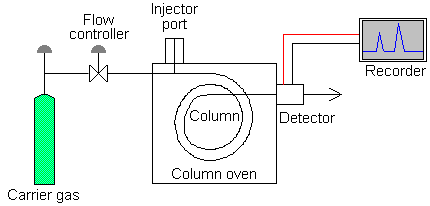
Gas chromatography, specifically gas-liquid chromatography, involves a sample being vapourised and injected onto the head of the chromatographic column. The sample is transported through the column by the flow of inert, gaseous mobile phase. The column itself contains a liquid stationary phase which is adsorbed onto the surface of an inert solid.
The mobile phase (carrier gas) is comprised of an inert gas e.g. helium, argon, nitrogen, etc. The stationary phase consists of a packed column where the packing or solid support itself acts as stationary phase, or is coated with the liquid stationary phase (high boiling polymer).
The main reason why different compounds can be separated this way is the interaction of the compound with the stationary phase. The stronger the interaction is the longer the compound remains attached to the stationary phase, and the more time it takes to go through the column (longer retention time).
References
- Gas Chromatography Theory. 2013. Gas Chromatography Theory. [ONLINE] Available at: http://www.chem.ucla.edu/~bacher/General/30BL/gc/theory.html.
- Gas Chromatography. 2013. Gas Chromatography. [ONLINE] Available at: http://teaching.shu.ac.uk/hwb/chemistry/tutorials/chrom/gaschrm.htm.

No comments:
Post a Comment