Tuesday, January 29, 2013

Gas Chromatography: An Introduction

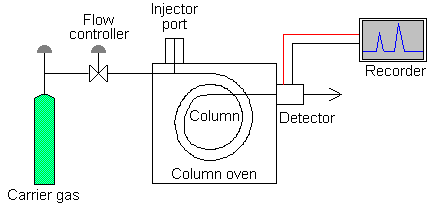
Gas chromatography, specifically gas-liquid chromatography, involves a sample being vapourised and injected onto the head of the chromatographic column. The sample is transported through the column by the flow of inert, gaseous mobile phase. The column itself contains a liquid stationary phase which is adsorbed onto the surface of an inert solid.

The mobile phase (carrier gas) is comprised of an inert gas e.g. helium, argon, nitrogen, etc. The stationary phase consists of a packed column where the packing or solid support itself acts as stationary phase, or is coated with the liquid stationary phase (high boiling polymer). 

The main reason why different compounds can be separated this way is the interaction of the compound with the stationary phase. The stronger the interaction is the longer the compound remains attached to the stationary phase, and the more time it takes to go through the column (longer retention time).


References
    • Gas Chromatography Theory. 2013. Gas Chromatography Theory. [ONLINE] Available at: http://www.chem.ucla.edu/~bacher/General/30BL/gc/theory.html. 
    • Gas Chromatography. 2013. Gas Chromatography. [ONLINE] Available at: http://teaching.shu.ac.uk/hwb/chemistry/tutorials/chrom/gaschrm.htm.

    Monday, January 28, 2013

    Saturday, January 26, 2013

    Gas Chromatography: Headspace Sampling

    Simple Definition


    Headspace' is the gas space above the sample in a chromatography vial. Volatile sample components diffuse into the gas phase, forming the headspace gas. Headspace analysis is therefore the analysis of the components present in that gas.

    Suitability

    Headspace gas chromatography is most suited to the analysis of the very light volatiles in samples that can be efficiently partitioned into the headspace gas volume from the liquid or solid matrix sample. Higher boiling volatiles and semi-volatiles are not detectable with this technique due to their low partition in the gas headspace volume. Partitioning is covered in more detail later in this article.
    Headspace gas analysis also lends itself to automation for quality control or sample screening. This is made possible by modern instrumentation, through which highly reproducible samples can be prepared in an efficient and accurate manner.

    Complex sample matrices, which may be difficult to analyse directly or would otherwise require sample extraction or preparation, are ideal candidates for headspace since they can be placed directly in a vial with little or no preparation. This saves both time and money.

    Applications

    Headspace GC is used for the analysis of volatile and semi-volatile organics in solid, liquid and gas samples. The popularity of this technique has grown over recent years and has now gained worldwide acceptance for analyses of alcohols in blood and residual solvents in pharmaceutical products.
    Other common applications include industrial analyses of monomers in polymers and plastic, flavour compounds in beverages and food products, and fragrances in perfumes and cosmetics


    Friday, January 25, 2013

    The Main Problem


    Furan is naturally occurring at low levels in many foods and drinks. Furan consumption is of concern because it has been classified by the International Agency for Research on Cancer (IARC) as possibly carcinogenic to mankind, based on studies with laboratory animals. Furan at a dose of 2 mg/kg body weight (bw) and 4 mg/kg bw has been shown to cause bile duct cancer in rats and liver cancer in mice.

    The U.S. FDA has recently published a report on the occurrence of furan in a large number of thermally processed foods, especially canned and jarred foods, including baby foods and infant formulas.  Of all the foods tested in various papers, coffee contained the largest amount of furan. It is highly volatile and hence its amount can be known easily by analytic chemistry.


    The primary source of furan in food is considered to be thermal degradation of carbohydrates, such as glucose, lactose and fructose.

    How it forms in coffee?


    Furan, like acrylamide, is one of a group of carcinogenic substances that can form when foods and drinks are subject to heat treatment. They are the result of a reaction, known as the Maillard reaction, between carbohydrates, unsaturated fatty acids and ascorbic acids or its derivatives.

    Level of tolerance?

    For a woman (54.5 kg) and a man (72.7 kg), 109 and 145.4 mg, respectively, can be considered as a safe upper limit.


    References
    • Questions and Answers on the Occurrence of Furan in Food. 2013. Questions and Answers on the Occurrence of Furan in Food. [ONLINE] Available at: http://www.fda.gov/food/foodsafety/foodcontaminantsadulteration/chemicalcontaminants/furan/ucm078451.htm. [Accessed 24 January 2013].
    • Exploratory Data on Furan in Food: Individual Food Products. 2013. Exploratory Data on Furan in Food: Individual Food Products. [ONLINE] Available at: http://www.fda.gov/Food/FoodSafety/FoodContaminantsAdulteration/ChemicalContaminants/Furan/ucm078439.htm. [Accessed 24 January 2013].
    • Coffee made from capsules contains furan, a carcinogenic substance | Spain Review. 2013. Coffee made from capsules contains furan, a carcinogenic substance | Spain Review. [ONLINE] Available at: http://www.spainreview.net/index.php/2011/04/14/coffee-made-from-capsules-contains-furan-a-carcinogenic-substance/. [Accessed 24 January 2013].
    • Determination of Furan in Food by Gas ChromatographyMass Spectrometry and Headspace Sampling. 2013. . [ONLINE] Available at: http://www.perkinelmer.com/CMSResources/Images/44-74134APP_FuraninFoodbyGCMS.pdf. [Accessed 24 January 2013].

    Detecting Furan: Materials & Equipment

    Equipments used  

                                                                                      
    The PerkinElmer® Clarus® 680 Gas Chromatograph with Claus 600C Mass spectrometer (GC-MS)


    TurboMatrix™ HS-40 system


    Materials Used 

    1)Stock solution of 1000μg/mL Furan and furan-d4.( Used to prepare standard)
    2)  Samples to be tested.
     [Lab coffee, Chocolate flavored milk(AKCF), Espresso Coffee, Coffee Flavored milk(AKC), Cocoa  Flavored Milk(AKK), Energy drink(milk based, NAEM), Brewed Coffee, Filtered Cofee]

    Thursday, January 24, 2013

    Dectecting Furan: Method


    The method below will demonstrate a rapid method for the identification and quantification of
    furan in food samples, using gas chromatography with headspace sampling and mass spectrometry.
    In addition to method optimization and standard analysis,  a number of food samples were analysed for furan.

    Coffee containing drinks, sauces, and canned foods, were chosen for the study as previous studies
    demonstrated high levels of furan in these foods. The samples were randomly collected from the local market.

    1) Preparation of Standard 


    A stock solution of 1000 μg/mL of furan and furan-d4 was used as the starting point for all standard
    solutions. 10 μL of the stock furan solution was diluted to 10 mL in methanol to give a solution of 1 μg/mL. 20 μL of the stock furan-d4 solution was diluted to 10 mL in methanol to give a solution of 2 μg/mL.

    2) Calibration 


    3) Sample Preparation


    Samples were collected from the local market. All the samples were refrigerated before analysis. 10 mL of sample was transferred into a headspace vial; 4 g of NaCl was added to it to decrease miscibility of furan with water. Milk and other viscous liquids are subjected to dilution of 1:2  or 1:4. Coffee was brewed as stated on the package and is treated like a non-viscous liquid sample. Semi solid samples are grounded post experiment and 5g of the powder is added together with 5 ml of saturated NaCl solution.

    4) Method Validation

    The method was validated by spiking the coffee sample with furan at 3 different levels. at 2, 5 and 10 μg/L. The measured amount was 2.03, 5.44, 9.54 μg/L demonstrating that the headspace technique is quantitative
    in its extraction of furan from an aqueous matrix.


    Why specifically headspace sampling as a method?

    Headspace sampling is the most suitable method for the analysis of very volatile compounds. This is a relatively simple and well-proven methodology in which a food sample in liquid or slurry form is heated in a sealed vial to achieve equilibrium partition between the liquid phase and the gaseous headspace. The headspace gas is sampled and the vapour injected into a GC. The detection can be carried out by non-selective means such as FID or by mass spectrometry.


    Tuesday, January 22, 2013

    Detecting Furan: Conclusion


    Results of the reaearch show that of all the eight samples analysed  using the HS-GC/MS method the brewed coffee was proved to have the highest levels of furan at 250 μg/L.

    Table 6. Sample Analysis Results.
    Amt. of Sample Furan Found
    No. Sample Details in ppb
    Sample 1 Lab Coffee 0.67
    Sample 2 Chocolate Flavored Milk (AKCF) 1.67
    Sample 3 Espresso Coffee 45.18
    Sample 4 Coffee Flavored Milk (AKC) 10.87
    Sample 5 Cocoa Flavored Milk (AKK) 1.76
    Sample 6 Energy Drink (milk based) (NAEM) 13.21 
    Sample 7 Brewed Coffee 36.59
    Sample 8 Filtered Coffee 253.99


    In conclusion, furan is rapidly and extensively absorbed from the intestine and the lung. It can pass through biological membranes and enter various organs. Experiments have shown that furan is carcinogenic to rats and mice, showing a dose-dependent increase in hepatocellular adenomas and carcinomas in both sexes. Furan has been classified as possibly carcinogenic for humans. However, preliminary exposure data suggest that the levels of furan found in foods are well below the levels that would cause harmful effects.

    Until more is known, FDA recommends that consumers eat a balanced diet, choosing a variety of foods that are low in trans-fat and saturated fat, and rich in high-fibre grains, fruits, and vegetables. Under the circumstances described previously, the continuation of the research is desirable
    for achieving safer and healthier foods

    Reference
    • Furan in Food – a Review. 2013. . [ONLINE] Available at: http://www.agriculturejournals.cz/publicFiles/04705.pdf. [Accessed 21 January 2013].

    Monday, January 21, 2013

    Results of other research works on furan levels in Coffee


    Furan and furan derivatives have long been known as intrinsic components of coffee flavours. Green coffee
    beans contain only traces of furan. The furan levels in the roasted coffee are correlated with the roast
    colour.

    The lowest furan concentrations were found in instant coffee with an average of  569  µg/kg. The highest furan levels were found in solid coffee with mean values varying between  600 µg/kg for instant coffee and 3,611 µg/kg for roasted coffee beans with the highest maximum of 6,900 µg/kg found in roasted ground coffee. In the non-coffee categories mean values ranged between 3.2 µg/kg for ‘infant formula’ and 40 µg/kg for certain ‘baby food’ categories. The highest maximum concentrations for the non-coffee categories were found in ’baby food’ with 224 µg/kg and ‘soups’ with 225 µg/kg.

    Automatic coffee machines produce brews with higher levels of furan, because a higher ratio of coffee powder to water is often used giving a lower dilution factor and because of the closed system favouring retention of furan. Standard home coffee-making machines produced much lower levels.  Furan will also dissipate from the serving cup, with higher losses at the beginning diminishing over time as the coffee cools down.

    Reference
    • Coffee made from capsules contains furan, a carcinogenic substance | Spain Review. 2013. Coffee made from capsules contains furan, a carcinogenic substance | Spain Review. [ONLINE] Available at: http://www.spainreview.net/index.php/2011/04/14/coffee-made-from-capsules-contains-furan-a-carcinogenic-substance/. [Accessed 24 January 2013].

    Sunday, January 20, 2013

    Concerns in the future - Furan in food

    Furan formation in food

    The exact conditions and mechanisms for the formation of furan have not been completely clarified. Several possibilities are being considered for the formation of furan in foods, all of them different, depending on the composition of the food. All relevant formation pathways underlie a heating process, such as boiling or roasting. The results of various investigations indicate that the cleavage of amino acids and sugar during the heating process plays a decisive role in the formation of furan. This does not exclude the possibility, however, that other ingredients, such as vitamin C or polyunsaturated fatty acids, could also contribute to the formation of furan during their heat-induced degradation

    What consumers can do to reduce Furan levels in food?

    Furan is an undesired substance detected mainly in heated foods. The data situation at present, however, is not sufficient to formulate unequivocal consumption recommendations. Various studies indicate that processing at lower temperatures reduces the furan content. Accordingly, the same recommendation applies for the minimization of furan as it does for acrylamide: “Don’t burn it, lightly brown it”. The furan content can also be reduced by preparing foods in an open vessel while stirring continuously. Because furan is a volatile substance, it tends to evaporate when the food is stirred.